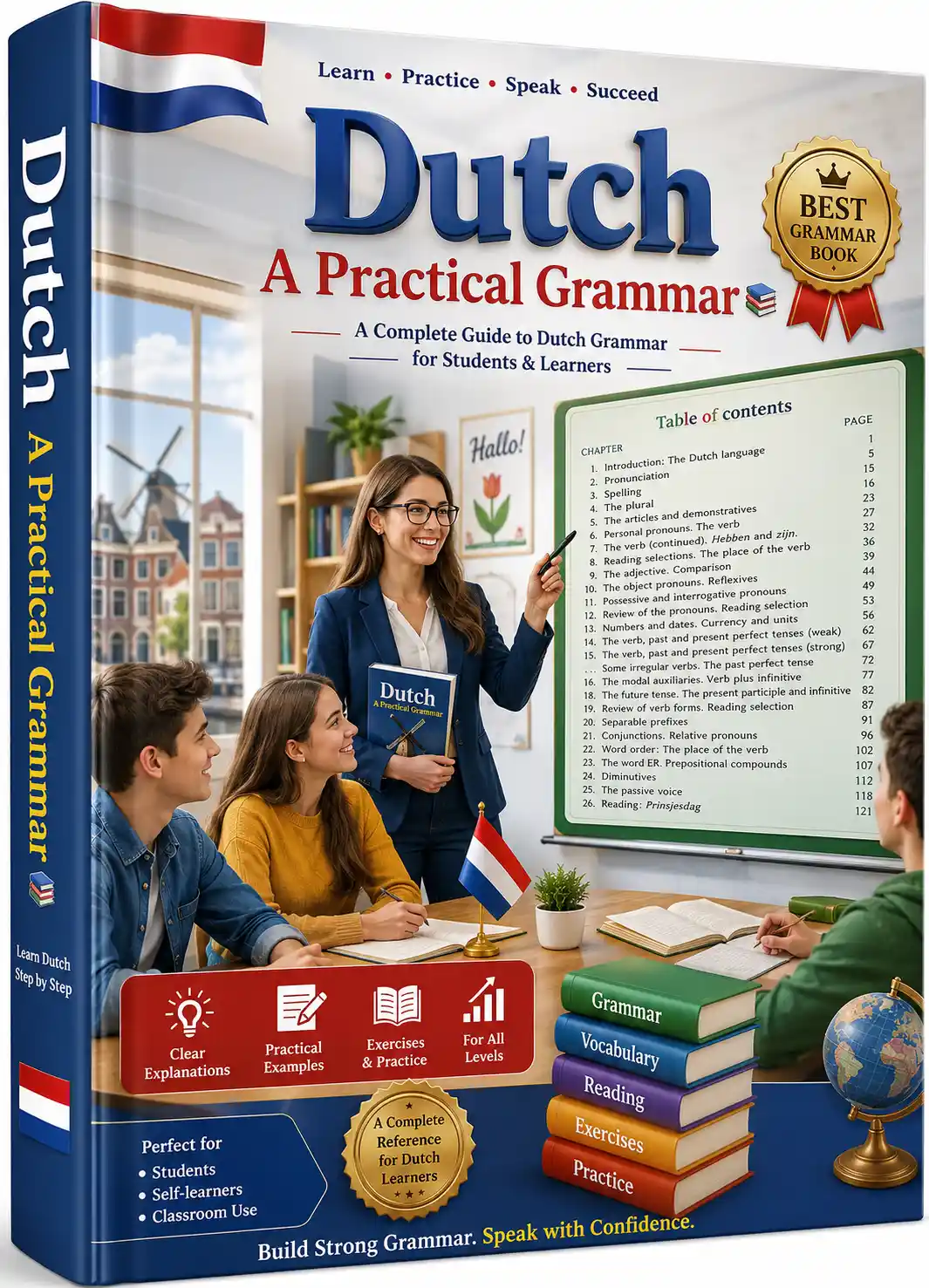
Dutch A Practical Grammer 📚
Dutch A Practical Grammer is a useful starting point for learners who want to understand Dutch grammar in a clear and practical way. Whether you are a complete beginner, a student, a traveler, or someone interested in improving everyday Dutch, learning the basic structure of the language can make communication much easier.
Build a Strong Foundation in Dutch
Grammar provides the framework for creating correct and understandable sentences. Dutch learners need to become familiar with word order, verbs, articles, nouns, adjectives, pronouns, prepositions, and common sentence patterns.
The Dutch A Practical Grammer approach focuses on learning grammar through practical examples rather than memorizing complicated rules without context. When a grammar point is introduced, learners can practice it in complete sentences and everyday situations. This makes it easier to understand how Dutch works in real communication.
For beginners, it is helpful to start with simple sentence structures. Learn how to introduce yourself, ask questions, describe people and objects, talk about daily activities, and express basic needs. Once these patterns become familiar, you can gradually move toward more complex structures.
Understand Important Dutch Grammar Rules
Dutch has several features that may be unfamiliar to English-speaking learners. Understanding definite and indefinite articles, for example, is important because Dutch uses de and het for definite nouns and een for an indefinite noun.
Verb conjugation is another essential area. Learners should practice common verbs in the present tense before moving on to past and future constructions. Word order is also important because the position of verbs can change depending on the type of sentence.
The Dutch A Practical Grammer resource can help learners review these topics systematically. Instead of trying to learn every rule at once, focus on one grammar area at a time and practice it repeatedly.
Improve Vocabulary Through Grammar Practice
Grammar and vocabulary work best when they are studied together. When learning a new verb, create several sentences with it. When learning a noun, learn its article and use it in a practical phrase. This approach helps you remember vocabulary while reinforcing correct grammar.
Writing short paragraphs can also be useful. Describe your family, your home, your daily routine, or your plans for the weekend. Then check the sentence structure and verb forms.
The Dutch A Practical Grammer approach can support classroom learning, independent study, and regular revision. It can also serve as a foundation before progressing to more advanced Dutch materials.
Learn Dutch with Consistent Practice
Language learning takes time, but regular practice can produce steady progress. Spend a few minutes each day reviewing grammar, reading simple Dutch texts, listening to native speakers, and creating your own sentences.
For learners who want a practical foundation in Dutch grammar, Dutch A Practical Grammer can be a useful addition to a structured learning routine. By combining grammar study with vocabulary, reading, listening, and speaking practice, you can gradually build accuracy and confidence in Dutch.